


Rent the Energy Laser L400
We offer the option of renting the laser or trying it out for a rental fee before purchasing. If you buy a laser after the trial period, 50% of the rental fee will be credited toward the purchase.
Rental terms
The rental period begins on the date of delivery. Once the rental period has ended, please return the device to us. A return label is included (for purchases within Germany only). Details of the rental terms are set out in Section 8 of our Terms and Conditions.
Laser therapy device for treating dogs, cats and horses
Handy low-level laser therapy device with an output of 400 mW and a wavelength of 808 nm. The Personal Laser L400 is one of the smallest low-level lasers on the market. Equipped with a powerful Li-ion battery, it ensures long treatment times.
The L400 is an effective, powerful all-round laser specifically designed to treat pain and injuries in horses, dogs and cats. Its 808 nm laser wavelength ensures effective penetration into the skin and tissue. Treatment depth: approx. 3–4 cm.
Why choose the PERSONAL-LASER™ L400?
The PERSONAL-LASER ™ L400 is the big brother of the L200 and the most powerful PERSONAL-LASER for private use. With a laser output of 400 mW at a wavelength of 808 nm (invisible/infrared), it covers all key applications. This allows pet owners to treat a wide range of conditions and injuries in dogs, cats and horses themselves.
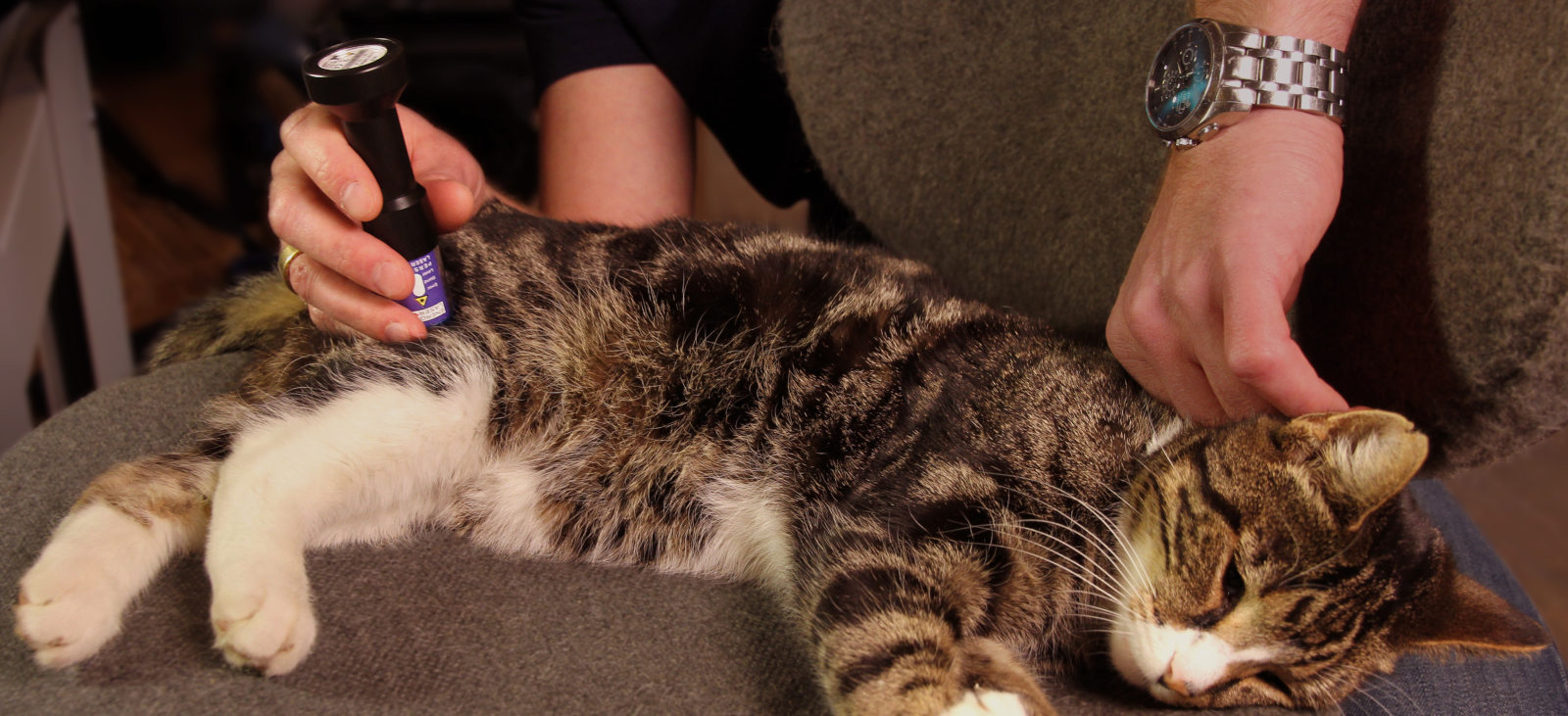
The L400 is significantly more powerful than its little brother, allowing the laser light to penetrate deeper into the skin, muscles, tendons and joints. Its higher output also reduces treatment times. The L400 is particularly well suited to treating deeper wounds and injuries.
Here are some basic properties attributed to laser light:
- Stimulation of cell metabolism
- ATP production
- Local concentration of lymphocytes, leukocytes and macrophages
- Improved blood circulation
- Stimulation of collagen production
- Improved oxygen uptake by cells - Normalization of the Na-K pump - Normalized cell membrane potential
The laser light generated by the L400 is monochromatic (a single wavelength), coherent (all photons move in the same phase and direction) and collimated (minimal divergence/spreading of the laser beam over a distance). These three properties allow the therapeutic laser light to be focused on a specific area of the body.
It also penetrates deeper tissues without heating or damaging them. With very few side effects, the laser beam can therefore interact with the tissue.

The optimal wavelength range for LLLT/PBM (photobiomodulation) applications is 600 nm to approx. 1000 nm. This is also known as the “biological window.” At longer wavelengths, the laser beam penetrates deeper into the tissue. At the same time, absorption by the animal’s hair and skin pigments is minimized.
Shorter wavelengths are used to treat superficial wounds and joint injuries. Longer wavelengths are better suited to laser therapy for muscle and tendon injuries.
The difference between LEDs and laser diodes
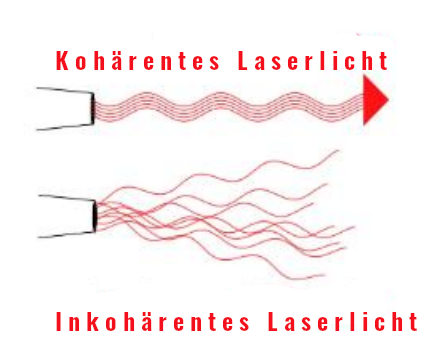 There are various veterinary lasers on the market that are sold for use in animal physiotherapy. Often, you will find LED devices described as laser therapy devices, but they differ in several ways from “true” lasers such as the Personal Laser L400.
LED stands for “light-emitting diode.” A diode emits light when an electric current passes through it, often in many different colors. LASER, on the other hand, stands for “Light Amplification by Stimulated Emission of Radiation.” A light source is first amplified in a medium and then emitted in a specific way, as described below.
A true veterinary laser is monochromatic. This means that the light it produces has a single, very specific wavelength. LEDs can also produce monochromatic or nearly monochromatic light. However, only true lasers such as the L400 concentrate all their power on a small point. Laser light is coherent (see illustration), and coherent light can travel much greater distances than incoherent light.
LEDs distribute their output over a larger area during treatment, but do not achieve greater tissue penetration, as is possible with the Personal Laser L400.
Calculating laser dosage and energy density
An important factor in laser therapy for animals is calculating the appropriate energy density for the condition or injury being treated. To calculate energy density, the units must be converted, including laser output from milliwatts to watts. For the L400, this is 0.4 watts.
Output, energy and time are related: output is the rate at which energy is delivered over time. The energy delivered by a laser can be calculated by multiplying its output by the treatment duration. For the L400, this is based on a treatment duration of 4 minutes.
Energy (delivered dose) = Output x Time = 0.4 W x 240 s = 96 joules (J)
Energy density is an important factor when carrying out laser treatment on animals. To calculate it, divide the energy delivered (J) by the area in square centimeters.
Energy density = Energy/Area (J/cm²)
Unit of output = watt (W)
Area = cm2
Energy = joule (J)
Energy density = joules per square centimeter (J/cm²)
Calculating energy density
| Area | Energy | Energy density |
| 100cm² | 96J | 0.96J/cm² |
| 10cm² | 96J | 9.6J/cm² |
| 1cm² | 96J | 96J/cm² |
LLLT laser treatment techniques
Laser treatment should be performed directly on the skin, avoiding thick fur where possible, as it can absorb some of the laser light.
To ensure effective laser treatment, please observe the following:
• Whether using the point or scan technique, the Personal Laser should ideally be applied in contact with the skin. This prevents the laser beam from losing energy through reflection off the skin, allowing more energy to penetrate the tissue.
• The laser should be held perpendicular to the treatment area. Otherwise, light energy may also be lost as the beam is deflected and reflected.
Applying light pressure to the skin with the L400 laser reduces blood flow in the treatment area. This reduces the absorption of laser energy by hemoglobin and oxyhemoglobin in the blood.
Scan treatment technique
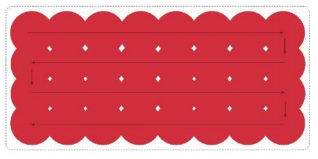 The scan technique is one of three treatment options available with the L400 veterinary laser. It is used for treating the area around the treatment site, larger areas (bite wounds, eczema, psoriasis, etc.) and, in particular, areas with dark, heavily pigmented skin, dark hair follicles or dark fur.
With the scan technique, the laser optics are pressed lightly against the skin. The laser is then moved in circular or rectangular motions over and around the treatment area.
Point treatment technique
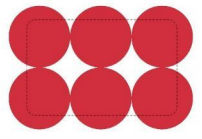 For point treatment, move the laser from point to point as shown in the image, leaving 1–2 cm between each point. Hold the laser at each point for the number of seconds specified in the veterinary dosage recommendations.
When treating bite wounds and eczema with a laser, hold it approx. 1 cm away from the skin. Only once the area just outside the open wound has been reached should the laser optics be gently pressed against the skin again.
Treating wounds
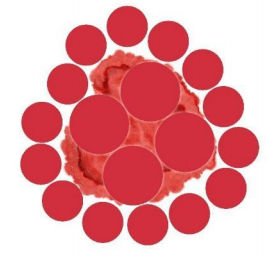 Bite wounds and other open skin lesions should only be treated along the wound edges, with the laser optics in contact with the skin (4 J/cm²). You can use either the point or scan technique. Treat inside the wound without the optics touching the skin (0.5–1 J/cm²). To do this, hold the L400 laser optics approx. 1 cm above the wound, then treat using the point or scan technique.
Interesting articles and information:
1. Laser dosage and treatment frequency for various conditions.
2. Laser therapy in veterinary medicine – properties, effects and safety
Legal notice: Statements on our product page about the possible applications of laser therapy and its expected effects are based on the experience of laser therapy users. This includes medical professionals (veterinarians and animal physiotherapists), many of whom have been using LLLT laser therapy in practice for years.
The descriptions of our laser therapy devices are not intended to suggest that using these devices will guarantee an improvement in symptoms. No guarantees of healing can be made. If your animal has symptoms, you should always consult a veterinarian first to discuss possible conventional medical treatments and complementary alternative therapies.
Sie haben noch Fragen zum Artikel Rental fee for the Personal Laser L400 – low-level laser for animals? Kontaktieren Sie uns gerne telefonisch unter 05561 3108680 oder mit dem Kontaktformular.
Ihre Ansprechpartner

Anna Scheglov, Medizinprodukteberaterin

Kateryna Atamanchuck, Kundensupport


