


The Primo Multidyne 970 electrotherapy device features all low and medium frequencies in a single therapy unit. Electrotherapy is used in all rehabilitation measures for the prevention of muscle atrophy due to musculoskeletal injuries to bones, joints, muscles, tendons, and ligaments.
All settings can be adjusted via a large touchscreen. Many fixed stimulation programs for various pathologies are available, and custom programs can be created and saved.
Low-frequency stimulation types
Diadynamic currents were introduced by Dr. Pierre Bernard. These involve various combinations of half-wave and full-wave rectified 50 Hz sine waves. The therapeutic benefits of diadynamic currents lie in pain relief, reduction of swelling and inflammation, increased local blood circulation, muscle strengthening, and retraining.
The Multidyne 970 produces DF (Diphasé fixe), MF (Monophasé fixe), CP (courtes périodes), CPiso (courtes périodes isodynamique), LP (Longues Périodes), and RS (Rhythme Syncope) waveforms. Pulsed 50 Hz sine currents can be used to trigger muscle contractions to generate rhythmic currents. This can be helpful in reducing edema and increasing blood flow in the treated area.
Faradic pulses are of short duration (less than 1 ms) and repeat at a rate of 50 Hz. They are usually surging to produce rhythmic muscle contractions.
Galvanic or direct current is used for pain relief and iontophoresis. A wide spectrum of interrupted galvanic pulses can be generated with the Multidyne 970. Rectangular pulses from 10µs to 1s and other forms from 1ms to 1s are available.
Trabert current, sometimes referred to as ultra-reizstrom, has a fixed pulse width of 2 ms and a period of 7 ms and is used for pain relief.
The Medi-Wave signal is a bipolar, exponentially decaying wave that emulates the H-waveform of nerve signals (Hoffman reflex). At low repetition frequencies (2 Hz), deep muscle-building stimulation can be achieved with Medi-Wave currents, while deep analgesic pain control can be achieved at higher frequencies (60 Hz).
Medium-frequency stimulation types
Interference therapy uses medium-frequency currents in 2- or 4-pole configurations to create a low-frequency stimulation effect. Before the introduction of interference therapy in the mid-1950s, low-frequency stimulation types were used for pain relief, muscle education, etc. However, these current types have the disadvantage that normal human skin has a relatively high impedance at such frequencies, which must be overcome.
To reach the desired impedance, a higher voltage must be used. However, this makes the treatment less comfortable for the patient. Furthermore, the penetration depth of these currents is low and partly limited by the discomfort to the patient, which requires the current intensity to remain relatively low.
Interference therapy can overcome the problem of skin impedance. At 50Hz (faradic current), the impedance for 100 cm2 of skin is about 3000 ohms. At 4000 Hz (medium frequency), the skin impedance for the same area is only 50 ohms.
As a result, a much lower voltage signal can be delivered to generate the desired current, which causes less skin irritation and ensures a more comfortable treatment.
However, this medium frequency is well outside the normal biological frequency range (0.1 to 250 Hz). To generate the required stimulation, two medium frequencies are used. A constant frequency of, for example, 4000 Hz is applied to one pair of electrodes, and a slightly different frequency of, for example, 3900 Hz is applied to the other pair.
These two frequencies "interfere" to produce an amplitude-modulated medium frequency (beat frequency) in the tissue. The tissue reacts to the cyclical rise and fall of the current intensity. It is the amplitude modulation frequency (AMF) that lies within the normal biological frequency range, not the medium frequency (carrier).
Russian stimulation was developed by Dr. Y. Kotz and operates with 2.5 kHz sine waves. These pulse at a low frequency to produce comfortable muscle contractions. KOTZ currents are similar to wavy 2-pole interference currents.
Medium-frequency currents are generated in bursts between 1 and 100 Hz. With variable operation, an overall envelope can also be applied with the desired rest times. The treatment time is selected in the same way as before.
The burst frequency can be set from 1 Hz to 100 Hz by touching the "Burst" button. 0-10 Hz is adjustable in 1 Hz steps, 10 - 50 Hz in 5 Hz steps, and 50 - 100 Hz in 10 Hz steps. The medium-frequency bursts used for Russian stimulation are surging to create work and rest times.
The work time is fixed at 10 seconds. The ratio sets the off or rest time in relation to the work time. For example: If the ratio is set to 1:4, the work time is 10 seconds and the rest time is 40 seconds. By pressing the "Ratio" button, the ratio can be set to any integer value between 1:1 and 1:5.
The status is displayed in the lower middle window of the display. Additionally, the constant current or constant voltage output mode can be selected via a dedicated button.
Transcutaneous Electrical Nerve Stimulation (TENS) refers to the application of low-intensity, short-duration pulses for the purpose of pain relief.
S/D Curve
In this program mode, rectangular interrupted galvanic pulses are generated to plot S/D curves. Output is from channel A only at constant voltage. To access this function, the S/D curve button is pressed in the list of stimulation types (after microcurrent).
The start pulse width can be set from 100ms to 1s, and the end pulse width from 10µs to 1ms. This defines the range of measurements and thus the start and end points of the S/D graph. A sufficient amount of time must be entered to complete the S/D test - 10 minutes should be more than sufficient.
With the correct electrodes, the current intensity on the muscle being tested is slowly increased until a muscle contraction occurs. The screen shows a flashing treatment icon, and the axes of the S/D diagram are displayed. 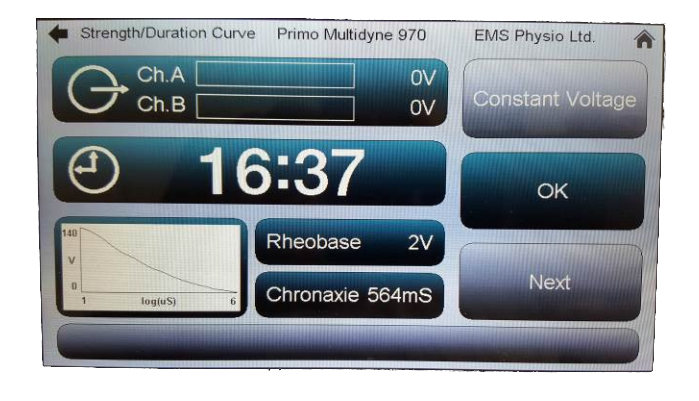
The graph at the bottom of the screen shows the pulse width, and the progress bar indicates when the pulse occurs. The pulse repetition rate is fixed at 20/min. As soon as a muscle contraction is detected, click on "Next". The first point of the S/D curve is recorded, and the pulse width is reduced to the next width setting.
Now the current intensity must be increased again until the next muscle contraction occurs - at this point, press "Next" again, and the next point in the S/D curve is plotted. This process is repeated until the pulse end width is reached. The S/D curve is now complete. Pressing "Stop" or manually reducing the current to zero causes the rheobase and chronaxie to be calculated and displayed.
The Multidyne 970 offers two channels with asymmetrical, symmetrical, or sequential output, with a variety of pulse widths and repetition rates. For interference vacuum therapy, it can be connected to the Vacuum 660.
With a special connection cable, the Multidyne 970 can also be used in combination with the Primo Therasonic 460 ultrasound therapy device. The display language can be set to German.
For further information on the device and available accessories, please feel free to contact us personally.
** Schedule an appointment for the orientation after receiving the product.
Do you still have questions about the item Primo Multidyne 970 Electrotherapy Device? Please feel free to contact us by phone at 05561 3108680 or using the contact form below.
Your Contacts

Anna Scheglov, Medical Device Consultant

Kateryna Atamanchuck, Customer Support


