


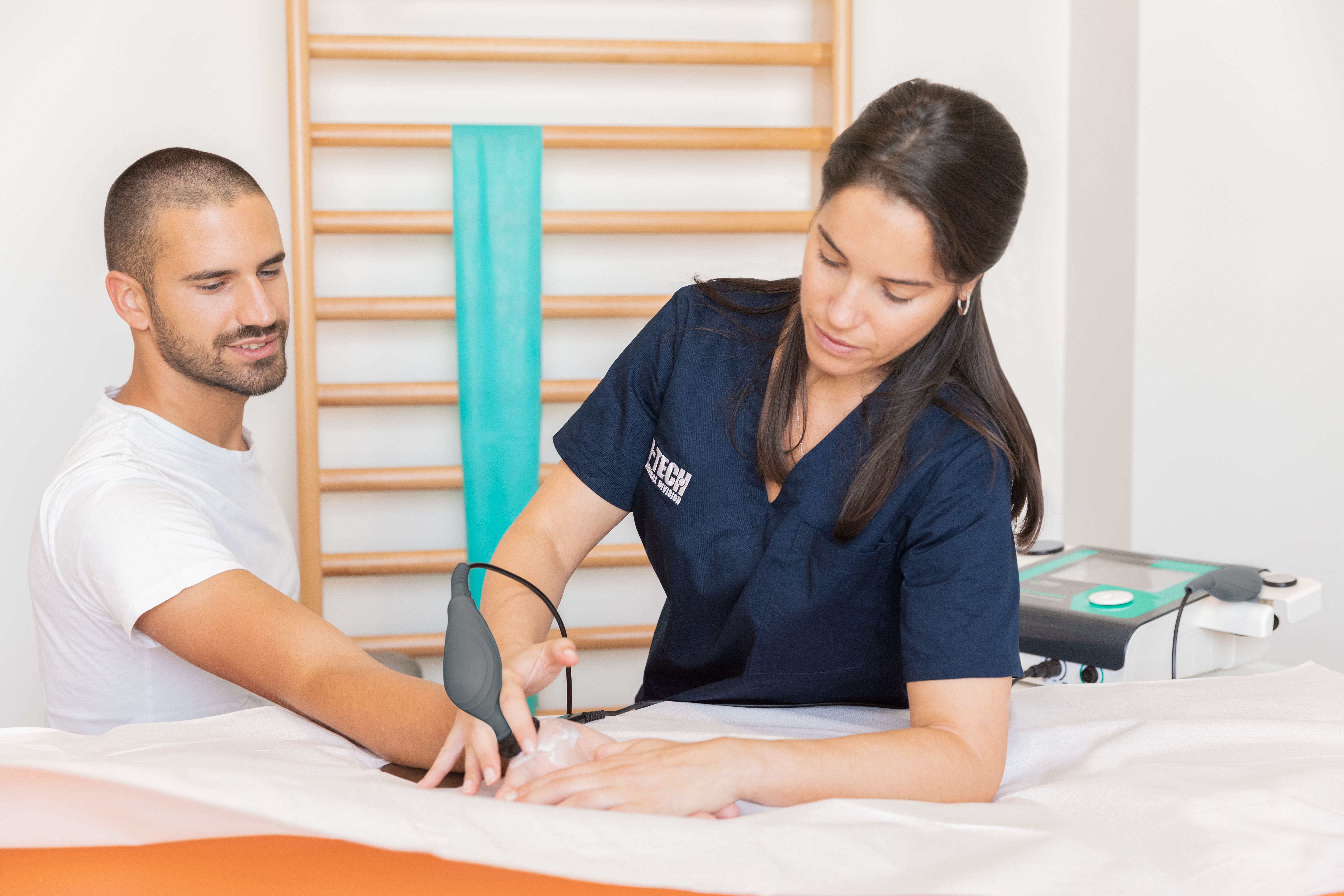
Reatherm – the advanced solution for capacitive-resistive diathermy with neuromodulatory functions. Are you looking for high-quality medical technology that meets both your needs and those of your patients? Reatherm, the top model from the Italian company I-TECH, offers just that.
Diathermy - Electrical therapy with medium frequencies
Diathermy, also known as Tecar therapy, is an electrotherapeutic method of physical therapy within medicine that generates heat in body tissue using high-frequency electrical current. Medium-frequency electrical current is used to transfer energy deep into human tissue, generating endogenous heat within the body. This produces the effects that physiotherapists often use to treat various medical conditions. This biostimulating therapy is suitable for rehabilitation, as well as in the sports and beauty sectors.
Why Reatherm?
Reatherm is a powerful device that combines capacitive resistive diathermy (Tecar therapy) with an innovative neuromodulation mode. This advanced technology allows you to offer a wide range of treatments that can be optimally adapted to the individual needs of your patients.
Versatile customization options
With the Reatherm's 400 freely adjustable frequencies ranging from 300 to 700 kHz and a modulation system from 1 to 100 Hz, you have the flexibility to precisely tailor your treatments. Whether it's for acute injuries or chronic conditions, you can tailor the therapy to achieve outstanding results.
Fast pain relief and comfort for patients
Your patients will reap the benefits of Reatherm therapy. Rapid pain relief and increased well-being, often achieved after just one session, are impressive effects of Tecar therapy. The combination of capacitive-resistive diathermy and neuromodulation offers an effective method for promoting healing and rehabilitation.
Application games for diathermy treatments
- Chondropathy
- Meniscopathy
- Edema
- Tendinitis
- Muscle contractures
- lumbago
- Lymphedema
- Herniated disc
- Tendon injuries
- Arthroplasty
Treatment modalities: Distinguishing features between capacitive and resistive approaches
Within the diathermy procedure, two types of treatment are used, depending on the intended purpose:
• The resistive method : This focuses the charge accumulation on tissues with increased resistance, located between the hand electrode and the counter electrode. The transfer occurs via a non-insulated electrode, which sets the charges in motion so that they act precisely in the deepest layers with higher resistance—this includes tissues such as bone, cartilage, tendons, and deep muscles.
• The capacitive approach. This treatment method increases the charge density in the area immediately beneath the moving electrode. This generates heat in the superficial tissue layers, including the vascular and lymphatic systems, fatty tissue, and superficial muscles. Capacitive contact is established via an electrode coated with insulating varnish, which mobilizes ionic charges in the subcutaneous tissue.
Athermal and thermogenic therapy
Although the term "diathermy" refers to its thermal effect, derived from the Greek words "through" and "heat," it is important to emphasize that this effect is not the only therapeutic mechanism of diathermy. In fact, it is possible to perform a treatment without inducing the thermogenic effect—this is called athermia.
• The thermal effect is caused by the effects of heat on nociceptors and contributes to reducing pain sensation. It is used in many conditions, especially chronic ones, as it also stimulates peripheral circulation. This effect can be easily regulated by the therapist through precise adjustment of the intensity of the treatment.
• In contrast, athermal treatment is characterized by the fact that it does not significantly increase blood flow, but maintains the biostimulatory effect induced by the electrical current in the tissue. For this reason, athermia is suitable for the treatment of inflammation and acute injuries, as it promotes the reduction of swelling, something that cannot be achieved with hyperthermic therapy.
Reatherm Programs
The Reatherm features 35 rehabilitation programs, 10 sports programs, and 5 beauty programs. Additionally, you can set and save your own programs, with 10 memory slots available.
Key data
- Color display
- 35 REHAB programs
- 5 BEAUTY programs
- 10 SPORT programs
- CUSTOM mode
- 10 free storage spaces
- Power 200 W, frequency 300÷700 kHz
- Modulation up to 100 Hz
Scope of delivery
The Reatherm comes with the following:
1x Resistive handpiece
1x Capacitive handpiece
1x Capacitive electrodes 60 mm and 35 mm Ø
1x Resistive electrodes 60 mm and 35 mm Ø
1x bipolar handpiece with electrode 50 mm Ø
1x plate electrode
1x bottle of diathermy cream
List of programs in Reatherm
rehabilitation
- Phantom pain
- Knee osteoarthritis
- Arthrosynovitis
- Bursitis / inflammation of the bursa
- Neck pain
- Whiplash
- Chondropathie
- Muscle contracture
- bruise
- Muscle overstretching
- ATM dysfunction
- sprain
- Muscle strain
- Joint pain
- edema
- Enthesis
- Epicondylitis
- Epitrochleitis
- Herniated disc
- Scarring
- LCA
- Lymphedema
- lumbago
- Lumbischialgia
- Meniscopathy (meniscal synovitis)
- Diabetic foot
- Piriformis syndrome
- Muscle strain
- Acute tendonitis
- Chronic tendonitis
- Rotator cuff tendinopathy
- ulcer
- bruise
- Arthroplasty (rehabilitation)
- Fractures
sport
- Muscle contracture
- bruise
- Muscle regeneration
- sprain
- Hematoma
- Tendon injury
- Surface massage
- Deep tissue massage
- Muscle overstretching
- Muscle strain
Beauty
- Cellulite
- Collagen
- edema
- Draining massage
- Microlifting
Frequently asked questions:
-
What is Tecar therapy?
- Tecar therapy, also known as diathermy, is an innovative therapeutic technique that utilizes medium-frequency electrical currents. By transmitting energy deep into the tissues of the human body, this technique triggers biostimulation and has established itself as an indispensable method in rehabilitation, sports medicine, and even cosmetic treatments.
-
How does Tecar therapy work?
-
Tecar therapy is based on the physical principle of the capacitor. A capacitor consists of conductive electrode plates separated by an insulator, which exhibit a potential difference. In a diathermy device, the handpiece and the body tissue represent the electrodes, while the current generator operates in the long-wave frequency range. This creates endogenous energy in the tissue through the movement of ions and electrolytes due to forces of attraction and repulsion. Tecar therapy utilizes this property to produce an internal therapeutic effect and is particularly effective in deep tissue compared to other physical therapies.
-
-
Is Tecar therapy effective?
- With nearly three decades of clinical studies, Tecar therapy has established itself as an effective and efficient therapeutic method. It optimizes pain management, reduces inflammation, and promotes tissue regeneration through electromagnetic interactions. It is particularly effective at transferring energy to the body and creating a controlled increase in tissue temperature. The interaction between electromagnetic energy and tissue causes a flow of ions that promotes the release of endogenous substances such as cortisol and endorphins. This contributes to pain relief, reduction of edema, and inflammation. The therapy increases blood flow, strengthens the immune system, and promotes tissue regeneration, accelerating motor rehabilitation.
-
Which pathologies benefit from Tecar therapy?
- Tecar therapy has been shown to be beneficial for a variety of conditions, including tendonitis, muscle strains, joint pain, and more. Its versatility makes it an indispensable tool in both acute and chronic situations.
-
What distinguishes Tecar therapy?
- Tecar therapy impresses with its multi-frequency capabilities, which allow for tailored treatments based on patient needs. The therapy's ability to penetrate deep into tissue makes it an excellent choice compared to other methods such as laser therapy.
-
Diathermy vs. Tecar - Why are there two names?
-
The terms diathermy, tecar, and tecartherapy are used interchangeably and refer to the same therapy. Diathermy describes the technique, while tecar is a commercial acronym derived from its main functions: capacitive-resistive electrical transfer (from the Spanish "Transferencia Energética Capacitiva y Resistiva").
-
-
For which diseases is diathermy used?
-
Diathermy is used to treat various conditions such as arthritis, back pain, muscle tension and musculoskeletal injuries.
-
Diathermy - Interesting Information
1. Diathermy and beauty treatments
2. Diathermy - the endogenous heat that regenerates
Sie haben noch Fragen zum Artikel I-Tech Reatherm TECAR therapy device ? Kontaktieren Sie uns gerne telefonisch unter 05561 3108680 oder mit dem Kontaktformular.
Ihre Ansprechpartner

Anna Scheglov, Medizinprodukteberaterin

Kateryna Atamanchuck, Kundensupport